
Written by Joy Hsueh
Medically reviewed by Joy Hsueh, AHPRA-registered Chinese Medicine Practitioner (CMR), Master of Chinese Medicine· 17 Aug 2026
AHPRA registered practitioner with a Master of Chinese Medicine and over 17 years of clinical experience in Traditional Chinese Medicine. Member of AACMA and ATMS.
Yes — in almost all cases you can eat Chinese food while pregnant. The cuisine itself is not the problem, and there is nothing about Chinese cooking that makes it riskier than any other restaurant food. What matters is how a particular dish is prepared, how long it has been sitting, and how hot it is when it reaches you.
That distinction gets lost in most advice, so here is the practical version: which dishes are genuinely worth avoiding, which are fine, what to say when you order, and what the evidence actually says about MSG.
The short answer
Safe: anything freshly cooked and served steaming hot — stir-fries, steamed fish, braised dishes, soups, freshly steamed rice, hot dumplings.
Avoid: cold ready-to-eat items, buffet and bain-marie food that has been held warm, raw or lightly cooked bean sprouts, sashimi and raw seafood, shark (flake) and billfish, and any herbal tonic soup whose ingredients you cannot confirm.
The reasoning behind each of these is worth understanding, because it lets you make the call yourself at any restaurant.
Why temperature matters more than cuisine
The main food-borne risk in pregnancy is Listeria monocytogenes. Pregnancy alters immune function, which makes listeriosis both more likely and more serious — it can cause miscarriage, stillbirth and severe infection in newborns, and a pregnant person can be quite unwell with it while their symptoms still look like mild flu.
Listeria has one property that shapes all the advice that follows: unlike most food-borne bacteria, it continues to grow at refrigerator temperatures. Chilling food does not stop it. Thorough cooking does kill it. That single fact explains why the guidance is not about which foods are dirty, but about which foods are eaten without a final blast of heat.
So the question to ask about any dish is not "is this Chinese?" but "was this cooked just now, and is it hot?"
What to avoid, and why
Cold ready-to-eat dishes
This is the largest category and the one most people miss. It includes cold barbecue pork or duck from a display cabinet, cold jellyfish or seaweed salad, cold noodle and rice salads, prawn cocktails, and pre-dressed cold appetisers. All are ready-to-eat foods that may have been prepared hours earlier and refrigerated — precisely the conditions listeria tolerates.
The same logic applies to sushi-style items and any cold seafood. If it arrives cold and was not cooked to order, leave it.
Buffets and bain-marie food
Food held warm in a tray sits in the temperature range where bacteria multiply most readily, and it is impossible to know how long it has been there. This applies to hotel buffets, food-court bain-maries and yum cha trolleys that have been circulating for a while. Freshly steamed dumplings brought straight from the kitchen are a different matter — ask for them hot.
Rice that was not cooked fresh
Uncooked rice commonly carries spores of Bacillus cereus, and those spores survive cooking. If cooked rice is then left at room temperature, the surviving spores germinate and produce a toxin that reheating does not destroy. This is why fried rice — which is traditionally made from rice cooked earlier and cooled — deserves a moment's thought.
A busy restaurant cooking rice in batches through service is generally fine. Rice that has been sitting in a warmer since lunch is not. Freshly steamed rice is always the safer order, and it is never a strange thing to ask for.
Raw or lightly cooked bean sprouts
Sprouts are grown in warm, humid conditions that suit bacterial growth, and contamination sits inside the sprout where washing cannot reach it. Raw sprouts are on the avoid list in pregnancy. They turn up raw as a garnish in noodle soups and fresh rice-paper rolls — ask for them left out, or make sure they are cooked through in the broth.
Undercooked egg, meat and seafood
Soft-set or runny egg dishes, pink pork or chicken, and lightly seared seafood should all be sent back. Egg drop soup and steamed egg custard are fully cooked and fine. Century eggs are cured rather than cooked and are best skipped in pregnancy.
High-mercury fish
Fish is genuinely good for you in pregnancy — it is a primary source of the omega-3 fatty acids that support fetal brain development, and Food Standards Australia New Zealand is explicit that pregnant women should not stop eating it. The caution applies only to species that accumulate methylmercury.
In an Australian Chinese restaurant the one to watch is flake, which is shark, and which appears in fried fish dishes. Billfish (swordfish, broadbill, marlin) and orange roughy are the others. FSANZ advises no more than one serve per fortnight of shark or billfish during pregnancy, and no other fish that fortnight. Barramundi, snapper, bream, whiting, salmon, prawns, calamari and canned tuna are all low-mercury and unrestricted.
The MSG question
This is the concern people raise most often, and the evidence does not support it.
Monosodium glutamate is the sodium salt of glutamate, an amino acid present naturally in tomatoes, parmesan, mushrooms, soy sauce and human breast milk. It has been evaluated by the major food safety authorities — including FSANZ, the European Food Safety Authority and the Joint FAO/WHO Expert Committee on Food Additives — and is considered safe at the levels found in food.
The cluster of symptoms once labelled "Chinese restaurant syndrome" has been examined repeatedly and the reviews find little supporting evidence; the studies claiming harm generally used doses far above anything achievable by eating. There is no good evidence that dietary MSG harms a pregnancy.
That said, if you personally notice headache or flushing after certain meals, avoiding those meals is a perfectly reasonable response — you do not need a mechanism to justify not eating something that makes you feel unwell. It is simply not a pregnancy-specific risk.
Sodium is the more reasonable concern
The ingredient genuinely worth moderating is salt. Soy sauce, oyster sauce, black bean sauce and stock bases are all high in sodium, and a single takeaway serve can carry a substantial share of a day's intake. For most pregnancies this matters little. It matters more if you are managing blood pressure, or if swelling in your feet and hands is already troubling you in the third trimester.
Practical adjustments: ask for sauce on the side, choose steamed dishes over sauced ones, order plain rice rather than fried, and drink water with the meal.
Herbal soups and tonics — the part most guides miss
This is where a Chinese restaurant differs from any other, and where general food-safety advice runs out.
Many Chinese restaurants serve herbal tonic soups — often described as "nourishing", "double-boiled" or "tonic" on the menu — containing medicinal herbs alongside the meat and vegetables. These are food-grade preparations, not prescriptions, and the quantities are usually modest. But several herbs that appear in them are traditionally used with caution in pregnancy, or avoided altogether in the first trimester.
Dang gui (Angelica sinensis) is the most common example: it is a blood-moving herb, widely used in women's health formulas, and one that a practitioner would think carefully about before giving to someone in early pregnancy. Others that turn up in tonic soups are similarly not chosen with pregnancy in mind, because the soup was not designed for a pregnant person.
You do not need to avoid herbal soups categorically. You do need to know what is in the one in front of you. Ask what herbs the soup contains; if the staff cannot tell you, order something else. And if you want the benefits of Chinese herbal medicine during pregnancy, that belongs in a prescribed formula from a practitioner who knows your history and your stage of pregnancy — not in a restaurant soup.
The same applies in reverse to anything you are already taking. If you are seeing a practitioner for pregnancy care, tell them what you eat regularly, herbal soups included.
How to order well
- Choose dishes cooked to order — stir-fries, steamed whole fish, braises, clay pot dishes, hot soups.
- Ask for it hot. "Freshly made and piping hot, please — I'm pregnant" is a normal request and kitchens handle it constantly.
- Order steamed rice rather than fried, unless you can see the wok working.
- Skip the cold entrée platter and anything from a display cabinet.
- Have dumplings steamed and hot, straight from the kitchen rather than off a trolley.
- Ask about the fish if a dish just says "fish fillet" — flake is shark.
- Ask what is in the tonic soup before ordering it.
- Take leftovers home promptly, refrigerate within an hour, reheat once until steaming, and do not keep cooked rice more than a day.
If you have already eaten something on this list
Try not to panic. The absolute risk from any single meal is low — these precautions reduce an already small probability, and most people who eat a cold entrée in pregnancy are entirely fine.
What matters is knowing the signs. Listeriosis can take anywhere from a few days to several weeks to appear, and it often looks like mild flu: fever, aches, headache, sometimes nausea or diarrhoea. If you develop a fever during pregnancy, contact your midwife, GP or maternity unit and mention what you ate. It is treatable with antibiotics, and treating it early is what protects the baby.
The Traditional Chinese Medicine view of eating in pregnancy
Food safety is one lens. Chinese medicine brings a different one, concerned less with contamination than with how a food's warming or cooling nature suits the person eating it and the stage they are at — favouring warm, cooked, easily digested food during pregnancy and treating cold, raw food as harder work for the digestion.
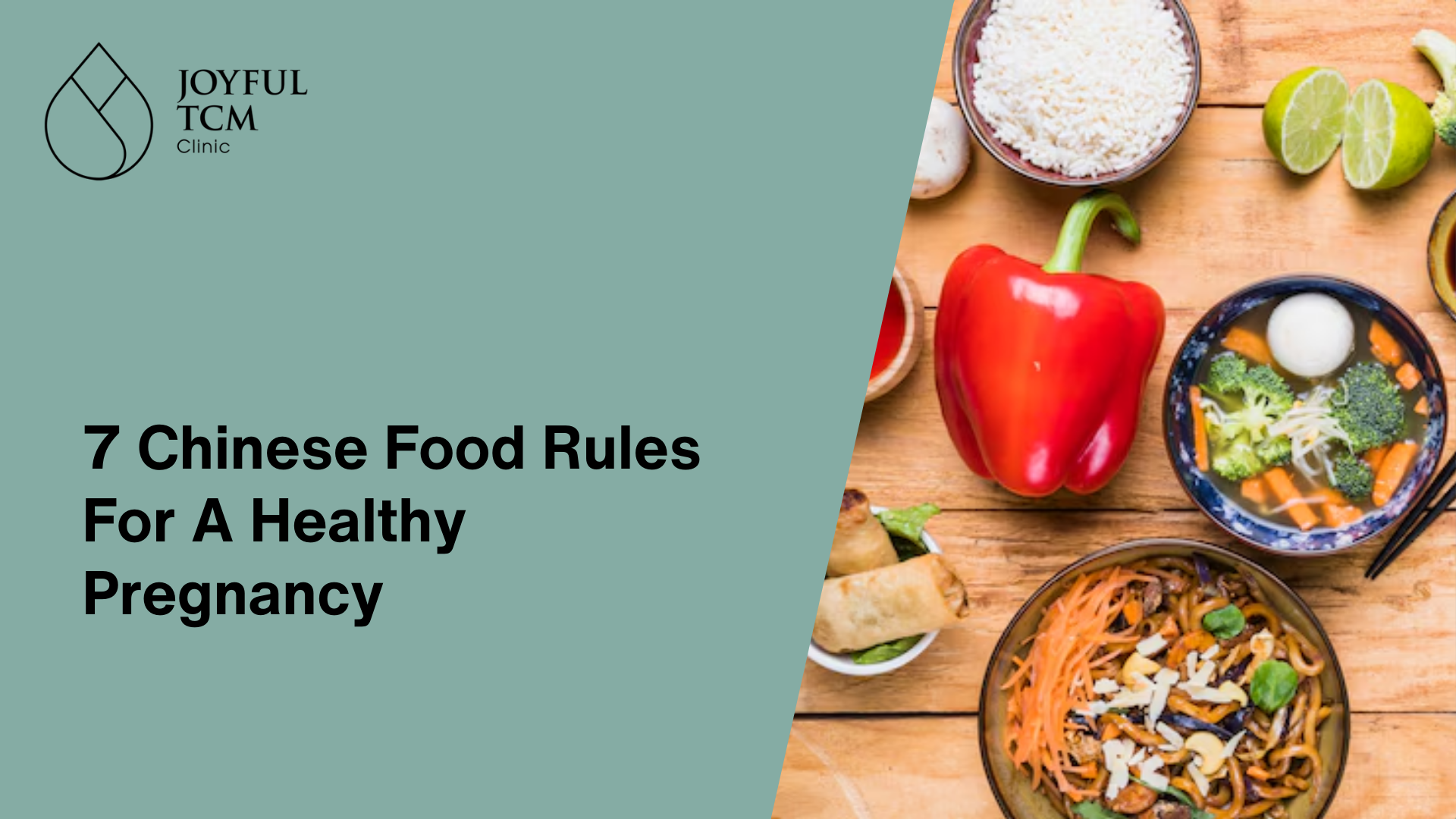
The two views converge on the same practical advice more often than not: eat food that is freshly cooked and warm. If you want that framework in detail, our guide to Chinese food rules for a healthy pregnancy covers the dietary principles, and which Chinese herbs pregnant women should avoid goes further into the herbal side.
Joy Hsueh has supported patients through pregnancy at our Bella Vista clinic for over 17 years, and questions about what is safe to eat come up at nearly every first appointment. If you would like guidance specific to your pregnancy — including whether anything you are currently taking is appropriate — you are welcome to get in touch.
References
- Listeria and listeriosis (opens in a new tab) — Healthdirect Australia
- Foods to eat or avoid when pregnant (opens in a new tab) — NSW Food Authority
- Pregnancy and healthy eating (opens in a new tab) — Food Standards Australia New Zealand
- Mercury in fish (opens in a new tab) — Food Standards Australia New Zealand
- Can reheating rice cause food poisoning? (opens in a new tab) — NHS
- A review of the alleged health hazards of monosodium glutamate (opens in a new tab) — Comprehensive Reviews in Food Science and Food Safety (2020)
Medical Disclaimer: This article covers general food safety in pregnancy and is not a substitute for advice from your midwife, GP or obstetrician. Food safety guidance changes, and individual circumstances vary — if you have a specific concern, or you have eaten something you are worried about, contact your maternity care provider. Never take a Chinese herbal formula in pregnancy except under the supervision of a registered practitioner who knows you are pregnant.